Add merge-date sorting to GitHub pull request lists
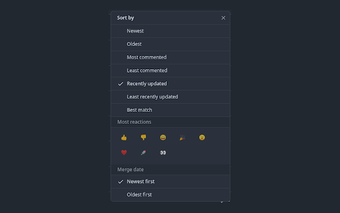
GitHub Sort by Merge Date, from Altxtech, is a Chrome extension that fixes GitHub's lack of PR sorting by merge timestamps. It adds a 'Merged date' option to the Pull Request sort dropdown, shows explicit merge timestamps and applies metaline styling for quick chronological scanning. The extension uses a pagination workaround to surface recently merged items and embeds its UI into GitHub so no external dashboard is needed. It's aimed at developers, DevOps engineers, and project managers who need accurate merge timelines for debugging and audits.
Adds merge-date sorting missing from GitHub's native options
The extension inserts a 'Merged date' choice into the Pull Request sort dropdown and writes explicit merge timestamps onto each PR row, using custom metaline styling to make chronological order visible at a glance. That change directly supports tasks such as debugging regression windows, auditing release timelines, and tracing when specific fixes entered a branch without leaving the GitHub interface.
Works around API limits by paginating and re-sorting locally
Because GitHub's API does not accept 'merged_at' as a direct sorting parameter, the extension uses the updated_at field for initial pagination, then applies a secondary sort by actual merge timestamp within each page. This intelligent pagination workaround surfaces the most recently merged pull requests first, but the ordering depends on page-by-page processing rather than a server-side global sort.
Keeps the interface compact while adding timeline cues
The extension embeds its elements into GitHub's existing layout without requiring an external dashboard, preserving the repository view while adding visual cues. Merge timestamps appear inline on the PR list, and the metaline styling helps scan sequences of merged work quickly. That in-place approach reduces context switching for reviewers who need to correlate merges with bug reports or deployment logs.
Designed for Chromium browsers and focused audit workflows
The extension runs on Chrome and other Chromium-based browsers such as Edge, Brave, and Opera, and it is maintained by the developer. It holds a perfect rating on the Chrome Web Store, reflecting positive reception. The main trade-off derives from the API constraint: because sorting uses page-by-page processing, very large repositories may require additional paging to expose older merged entries in chronological order.
Practical for teams needing accurate merge timelines, with a page-level trade-off
The extension delivers a focused solution for developers and managers who require chronological visibility of merged work, making audits and regression tracing easier. Its dependence on client-side, page-by-page sorting means repositories with long histories require extra paging to view older merges. Tip: narrow the pull-request list with filters before applying merge-date sorting to reduce paging and focus investigations. That approach suits sprint reviews and release audits.